

I don’t often find source material in The New York Post - but:
“A new Atlantis has emerged from the sands.
An amateur archaeologist has potentially made the discovery of a lifetime after uncovering the alleged ruins of a lost metropolis off Louisiana that predated modern US history.
“All I know is that someone built the city 12,000 years ago,” retired architect George Gelé claimed in a resurfaced WWLTV interview from 2022.
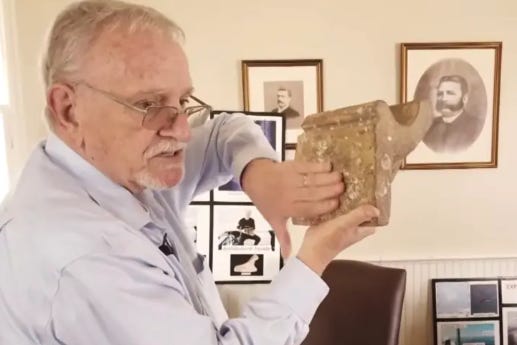
Gelé with a granite “rain gutter” artefact he claims was made about 12000 years ago near New Orleans
In the clip, Gelé claimed that for 50 years, he has been capturing sonar images of submerged structures off Chandeleur Islands, a chain of uninhabited barrier islands situated in the Gulf of Mexico around 50 miles east of New Orleans.
The mysterious buildings reportedly number in the hundreds and are located 30 feet below the water’s surface and are buried underneath an additional 100 feet of sediment.
The crown jewel of this so-called lost city is a so-called 280-foot pyramid jutting up from the ocean floor, which the architect claims emits a powerful electromagnetic signature that affects passing boats. In fact, he believes that these aquatic remnants are “geographically related to the Great Pyramid of Giza in Egypt.”
Gelé suggests the site flooded as the last “Ice Age” ended… and you know “ice ages” are local conditions based on the position of Earth’s crust, and which regions are at the poles - at the time in question. Greenland and Antarctica have an “ice age” now because they’re at the poles, as Hudson Bay was when North America had an “ice age.” So whatever currently underwater city once existed off the Louisiana coast, along with the pyramids and temples found off the western tip of Cuba almost 30 years ago -
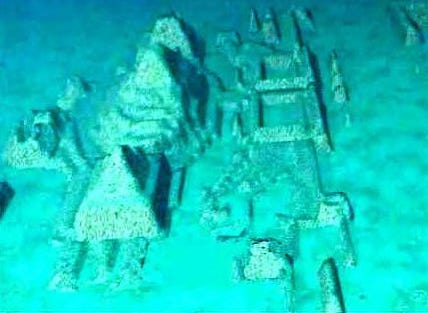
Sonar images taken in 2001 off Cuba’s western tip, 2000 ft down
existed prior to the last pole shift catastrophe over 12,000 years ago.