

If you follow my work you know my last book (published in October) is Hiding Hitler: The Offer America Couldn’t Refuse. The basic premise is that Hitler did not commit suicide in his bunker in Berlin on April 30, 1945 as the propaganda of the official historical narrative teaches. Evidence suggests he fled Berlin on April 22, (some think he fled as late as April 30) flew to Austria, then Spain, then to its Canary Islands, where a U-boat took him to Argentina by July 1945 for a second life.
Fellow author on this subject Peter David Orr recently posted an interesting article. In my book I had already quoted TIME Magazine (May 28, 1945) quoting an unidentified source stating that Hitler himself, at the end of the war, allegedly said: “While I live, there will be no conflict between Russia, America, and England. They are united to destroy me. If I’m dead, they can’t stick together; conflict will come. And when it arrives, I have to be alive to lead the Germans up from defeat to final victory. Germany can only think of victory if the people think that I’m dead.” That statement always reminded me of the scene in the movie Diehard, where the head villain Hans Gruber said “they will find you unless they think you’re already dead” and “we’ll blow the roof, they’ll spend a month sifting through the rubble, and by the time they figure out what went wrong, we’ll be sitting on a beach.”
Orr quoted a similar version of Hitler’s speech ending in “if the people think that I’m dead” from a publication in Milan, Italy - Giornale Lombardo - that came out shortly after the TIME article:
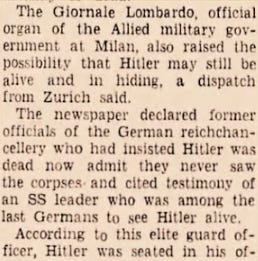
Orr focused on the vagueness of the un-named sources. “Officials” and “they” and “an SS Leader” and “an elite guard officer.” Why didn’t they name him? According to this nameless officer, Orr notes, “in the Reich Chancellery, Hitler was seated on a ‘divan’ in his office, with Eva Braun writing letters nearby. The SS leader recounted Hitler’s dramatic outburst: ‘While I live there will be no war between Russia, America and Britain. They wish for my destruction. If I disappear, they will not remain united long. A collision will be inevitable. It is imperative that when that time comes, I am alive to lead the German people to victory. The Reich cannot hope for any future unless the whole world believes me dead. I must…’ At that moment, Hitler asked the officer to leave the room.
The article also mentions a letter from Eva Braun to her parents, warning them not to worry if they didn’t hear from her ‘for a long time.’ This SS leader’s account, published just weeks after Berlin’s fall, suggested Hitler planned to fake his death. But who was this mysterious figure? I [Orr] set out to identify him, and what followed was a grueling investigation that led to more dead ends than answers.”
Orr compiled an extensive list of likely candidates - who would have been in the bunker in late April, fit the description of a high ranking SS officer, and were held by the Western Allies for interrogation within a month of Germany’s surrender. Then Orr eliminated all of the names on his list because they had either died, been captured by the Soviets, disappeared without a trace, or evaded capture until too late a date to have been the source for an article published June 6 (and May 28 in TIME.)
Orr “broadened the search to high-ranking SS officers in the bunker who might have had access to Hitler’s office, even if they weren’t strictly part of his security detail.” Orr eventually almost decided the source didn’t really exist: “Despite endless digging, no SS officer fits the criteria. Perhaps this ‘SS leader’ is a composite figure created by US intelligence for dramatic effect? In May 1945, the Allies were interrogating thousands of German POWs across Europe, and the Giornale Lombardo might have received a summarized report, blending accounts from bunker survivors. Alternatively, the newspaper could have misidentified the source or sensationalized the story to fuel speculation about Hitler’s fate. Considering this paper was the official mouthpiece of the US occupation forces in Northern Italy, it sure is a weirdly cagy admission.”
Then Orr remembered that Hitler, who initially expected to win the war, had formed a team to write down everything said at his meetings for future use in a comprehensive history of the war. (Of course Hitler’s version was never written because he lost, but imagine an alternate history version of Churchill’s Nobel-prize-winning six volume history of the war, if Germany had won.)
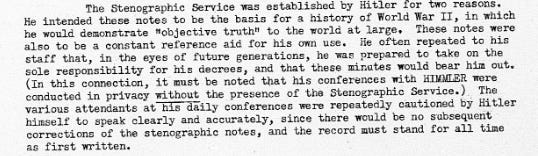
Orr continues: “The only Reich Chancellery officials in American hands before June, in Bavaria, who had been with Hitler, but were not there on the date of Hitler’s supposed suicide, were the legal secretaries (men) on Hitler’s personal staff at the Reich Chancellery who served as a shorthand experts and stenographers: Gerhard Herrgesell, Ludwig Krieger, Heinz Buchholl, Karl Thoet, Dr. Kurt Peschel, Dr. Ewald Reynitz, and Hans Helling. They were in American custody before May 15, 1945, in Berchtesgaden. Herrgesell was the spokesman of these officials… Herrgesell was employed by US Army CIC in Berchtesgaden as a translator and stenographer for the interrogations of Hitler’s chauffeur (also found/captured in Berchtesgaden). Herrgesell was even trusted to question Kempka alone, without supervision.
On several occasions in mid-May of ‘45, US Army Intelligence trotted Herrgesell out, at press conferences to dish juicy details about Hitler’s ‘last days’. For example, on May 18, Herrgesell told the gathered press corps about the last Fuehrer conference that he attended on April 22, 1945, saying Hitler proclamed, ‘I’m going to stay in Berlin. I won’t desert now. I will fall here before the Chancellery’ and emphasized that Hitler repeated these points at least ten times, [note that on April 22, hours before I think he fled Berlin, Hitler repeatedly made the point that he would not be leaving Berlin - ten times or more - for effect] followed by those present pleading with Hitler to ‘recant and agree to leave’. When one examines the Herrgesell appearances at press conferences from May 15-22, a clear picture emerges: Despite the fact that Herrgesell and his fellow stenographer departed Belin in the earliest morning hours of April 23, 1945, he was consistently painting a picture of Hitler’s suicide, as if he knew about it firsthand.
Now, take a look at the yellowed article on the right.” [Orr found another old, faded, but very relevant article.]

“Notice Herrgesell’s telling phrase at the end about Eva Braun. This match establishes Herrgesell and his Reich Chancellery stenographers as the officers quoted in the Giornale Lombardo article of June 6, 1945. Herrgesell was obviously involved in an interrogation of an unnamed elite SS guard who was with Hitler in Berlin in the end. What this man said during the interrogation forced Herrgesell and his colleagues to admit they hadn’t seen Hitler’s dead body because they hadn’t been in Berlin at the time of the supposed suicide. It was obviously the testimony of this unnamed ‘SS leader’ that made them change their tune.”
And it is known that Herrgesell was close to - and interrogated - SS-Obersturmbannführer (Lieutenant Colonel) Erich Kempka, Hitler’s chauffeur and chief of the Reich Chancellery motor pool.
“Erich Kempka is the last man standing. By default, he’s the “SS leader” in the Giornale Lombardo article.
Those familiar with Kempka’s official account, particularly his popular and oft-quoted memoirs, know that his interaction with Hitler in the Führerbunker… in which Hitler talks of faking his death, has never been repeated again...until now.”
Long story short, Peter David Orr did some nice extensive sleuthing and appears to have established Erich Kempka - the official source of most Allied propaganda claiming Hitler shot himself on April 30, 1945 - as the SS officer who, when not being quoted or named directly, admitted he never actually saw Hitler dead and that Hitler could have been alive. If you’re a WWII history addict and appreciate this sleuthing, Orr’s much longer full article is Unmasking a Shadowy SS Bunker Witness.
Also consider reading: Hitler’s Suicide: Reasonable Doubt

and Hiding Hitler: The Offer America Couldn’t Refuse

… which destroys the suicide myth by pointing out forensic fraud and contradictory eyewitness testimony, then reveals why and how the United States was willing to make a deal to reap the rewards of taking over Germany’s intelligence networks, looted wealth, and advanced technology projects to fight communism together.