

Many readers know that Egyptologists claim the Sphinx and the three main pyramids at Giza were built approximately 4,500 years ago. They have no idea how the primitive civilization in Egypt at the time could have built them, or why they were built. Geologist Robert Schoch claims erosion from rainfallproves the Sphinx in particular is many thousands of years older. A star map inside one of the “air shafts” in the Great Pyramid shows the sky as it was approximately 12,000 years ago. Edgar Cayce claimed these structures were built around 10,500 BC and that there is a Hall of Records from the days of Atlantis buried near the Sphinx. There is also a theory that the three pyramids are intentionally aligned like the three stars in Orion’s Belt.
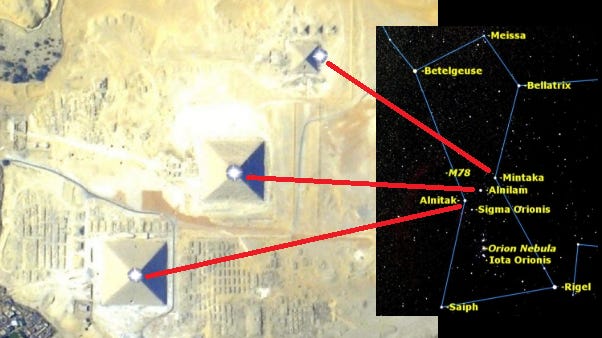
The problem is, they were placed in locations that form a 12 degree angle when in reality the line seen in the stars only has a 6 degree angle. Were the normally precise builders that far off? Or does Mintaka’s rate of stellar drift imply a much older construction date? (Read the 1994 book Orion’s Mystery by Robert Bauval and Adrian Gilbert for a full argument.)
As for the erosion evidence… Imagine there is an exposed block of stone for which we know exactly what year is was uncovered and exposed to the elements. We can measure the erosion that has occurred on that block, divide by the years that have gone by, and come up with an average annual rate. We can then measure the depth of erosion damage to stones with an unknown exposure date, and use this Relative Erosion Method to calculate the date of first exposure to the elements. Alberto Donini describes his erosion analysis: “REM is based on the ratio between two types of erosion affecting the same type of rock in the same location: one with a known date and the other with a date to be determined.” Simple.
“He concludes: ‘For these reasons, it is likely that the pyramids of Akhet Khufu and Khafra (G1 and G2) date back to approximately 19,000–23,000 BC, whereas at least two of the Queens’ pyramids (G1b and G1c), located adjacent to the Pyramid of Khufu, were constructed much later, presumably between 2,500 and 5,000 years BC. It is therefore plausible that the pharaohs Cheops and Chefren merely renovated the two largest pyramids on the Giza plateau, attributing their authorship to themselves, and possibly built the Queens’ pyramids.
On the basis of this preliminary report on relative erosion measurements (REM) carried out on selected pyramids of the Giza plateau, it can be concluded that around 20,000 years before Christ there existed a civilisation in Egypt capable of constructing at least the two main pyramids (G1 and G2)”
As my readers already know, the evidence suggests that there is a periodic cycle of civilization-ending pole shift catastrophes which brought the pre-Egyptians to a sudden end.

The real reason for precision blding; location & designed engineering would if known answer