
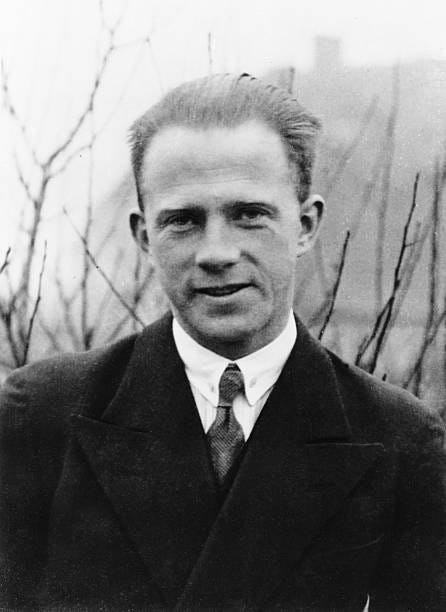
Werner Heisenberg, one of the greatest scientists from a nation known for its great scientists - died fifty years ago on February 1, 1976. Director of the Kaiser Wilhelm Institute for Physics, the Max Planck Institute for Physics, President of the German Research Council, Chairman of the Commission for Atomic Physics, Chairman of the Nuclear Physics Working Group, and President of the Alexander von Humboldt Foundation - he is known best for the Heisenberg uncertainty principle, which he published in 1927. He received the Nobel Prize in Physics in 1932 "for the creation of quantum mechanics."
Near the end of 1938, fellow German scientists Otto Hahn, Fritz Strassmann, and Lise Meitner discovered that bombarding a uranium atom’s nucleus with neutrons split the uranium into two other lighter elements and also released more neutrons. Not only did they prove that this nuclear alchemy could transmute elements - they had discovered nuclear fission. Within days, many nuclear physicists around the world realized this meant that unstable radioactive metals could be used to power atomic bombs. Europe was on the brink of WWII, and Germany’s scientists were estimated to be 18 months ahead of any other nation if Hitler were interested in developing atomic bombs.
Germany’s young rising star was in a perfect position to lead the project. In an alternate reality, he chose to do so: in Philip K. Dick’s world of The Man in the High Castle, WWII ends after Washington D.C. is burned under a mushroom cloud started by what that fictitious world came to know as the Heisenberg Device

Fortunately in our reality, Heisenberg disagreed with Nazi ideology, and despite his love for Germany he knew great cities would be destroyed and millions could be killed in an atomic war if he made the first atomic bombs for Hitler. History books deceptively tell us that Germany’s physicists both didn’t understand how to make atomic bombs (see Heisenberg’s credentials, above) and that they didn’t try. That when American armies rolled into Germany in 1945 our investigators discovered the atomic arms race they had worried about was a mirage, and that the Germans “were a hundred years behind.” That propaganda was necessary at the time.
But in reality, the German atomic bomb program was ahead of America’s Manhattan Project. Even with “politically unreliable” scientists like Heisenberg advising Nazi leaders that an atomic bomb program would be too expensive and take too long to determine the outcome of the war, other scientists more loyal to the Nazi cause did successfully develop the first atomic bombs in huge black budget programs like the one funded by the Reich Post Office. That their secret project succeeded too late to be used - after losing the air superiority need to carry Germany’s heaviest bombs to their targets - is a testament to men like Werner Heisenberg, who systematically sabotaged the morale for a German bomb program.
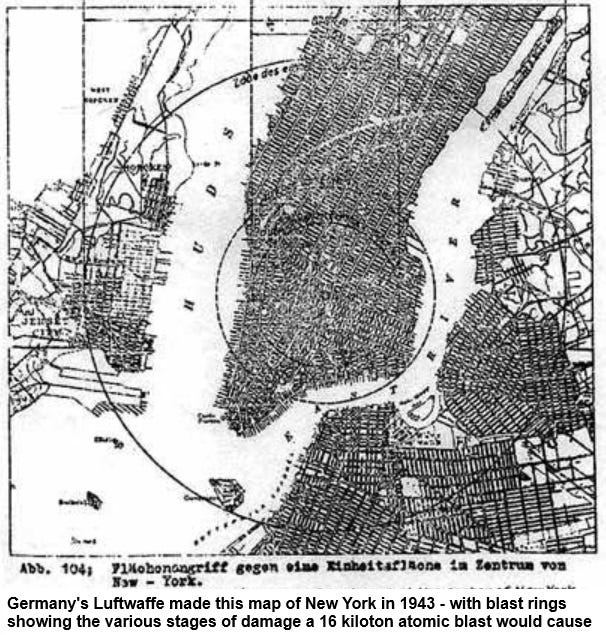
The true details of both the American and German atomic bomb programs - and how the Germans succeeded first but helped the Americans use them first - are fascinating. To learn the truth read books like Critical Mass, Forgotten Creators, Reich of the Black Sun, and especially: Oppenheimer and Heisenberg
